The RM12 Dinner Upgrade: How to Eat Like a Restaurant Chef Without Leaving Home
Let us do the math on eating out in Malaysia in 2026.
A decent restaurant meal — not fancy, just decent — runs you RM18 to RM30 per person. Add a drink, service charge, and SST, and you are looking at RM25 to RM40. Do that three times a week and you have spent RM300 to RM480 a month on food that someone else cooked.
Now let us do different math.
One bottle of Tanjong Sauce® costs RM12.90. It contains roughly 200 servings (three drops per serving). That is about 6.5 sen per meal. Over the course of a month — let us say two meals a day, 60 meals — you have spent less than RM4 on sauce.
The question is not whether you can afford to eat out. The question is whether you can afford to ignore the gap between what restaurant food tastes like and what home food could taste like with the right tool.
The Gap Is Not Skill. It Is Depth.
Restaurant food tastes different from home food for one primary reason: layers. Professional kitchens build flavour in stages. They bloom spices in hot oil. They deglaze pans with wine or stock. They finish dishes with acid, fat, and seasoning in precise sequence.
Home cooking, by contrast, tends to be linear. Heat pan, add ingredients, add salt, serve. There is nothing wrong with that — it feeds people. But it does not create the depth that makes restaurant food memorable.
This is where Tanjong Sauce® enters the equation. Not as a topping. As a cooking ingredient.
The Four-Layer Shortcut
Remember the flavour journey: sweetness first, then umami depth, then gentle heat, then a lingering warm finish with nutmeg. That is four layers of flavour in one ingredient.
When you add a teaspoon of Tanjong Sauce® to a stir-fry, a soup, or a pan sauce, you are not just adding heat. You are adding sweetness, savouriness, acidity, and aromatic warmth — all at once, in proportions that were tested and balanced by someone else. You are essentially outsourcing the hardest part of cooking (flavour balancing) to a bottle.
This is what restaurant chefs do with their house sauces and reductions. They build complex flavour bases in advance so that when service starts, they can finish dishes in minutes. Tanjong Sauce® is that base, pre-made, sitting in your pantry.
Three Real-World Applications
The 30-Second Pan Sauce
You have just pan-fried a chicken breast or a piece of fish. The pan has brown bits stuck to the bottom — that is flavour, not mess. Turn off the heat. Add a tablespoon of butter, a teaspoon of Tanjong Sauce®, and a splash of water. Stir until emulsified. Pour over your protein. You have just made a restaurant-quality pan sauce in 30 seconds. Cost: about 50 sen in ingredients, including the sauce.
The Soup Upgrade
Making instant soup? Clear chicken soup? Miso soup? Add half a teaspoon of Tanjong Sauce® before serving. The vinegar brightens the broth. The nutmeg adds an aromatic warmth that makes it taste like it simmered for hours. The chili gives it a gentle background heat that makes people ask “what is in this?”
The Fried Rice Elevation
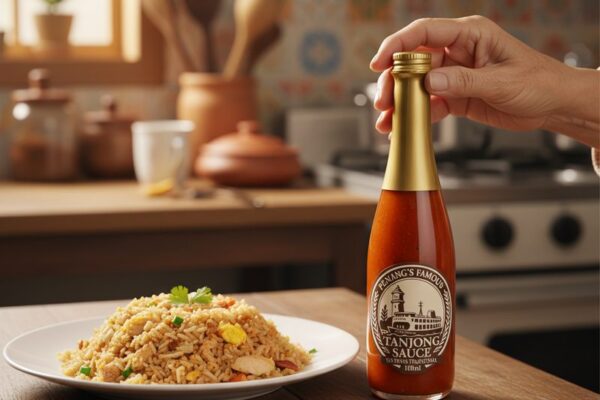
We covered this in Monday’s post, but it bears repeating: a teaspoon of Tanjong Sauce® in your fried rice replaces the aromatics step entirely. No need to fry garlic and shallots separately. The garlic powder and onion powder in the sauce bloom in the hot oil and do the work for you. Your fried rice gains depth without gaining prep time.
The Psychology of the Upgrade
Here is something restaurant consultants know and home cooks often do not: the difference between “home food” and “restaurant food” is often just one ingredient. One element that makes the eater think “I could not make this at home.”
For a lot of Malaysian home cooking, that missing element is depth. Not heat. Not salt. Not MSG. Depth. The sense that there is more going on in the dish than what you can immediately identify.
Nutmeg delivers that depth. Specifically, Penang nutmeg — warmer, more aromatic, with higher essential oil content than commodity nutmeg. It is an ingredient most home cooks do not keep in their pantry, and certainly do not think to add to savoury dishes. That unfamiliarity is exactly what creates the “how did you make this?” effect.
The Bottom Line
You do not need to go to culinary school to make food that tastes expensive. You need one ingredient that does the work of four. You need something that adds depth without adding time. You need a bottle that costs RM12.90 and lasts two months.
The restaurant experience is not about the tablecloth. It is about the flavour. And flavour, it turns out, is surprisingly affordable.
Get Tanjong Sauce® — RM12.90
World’s First Halal Nutmeg Hot Sauce. 100ml. Made in Penang, Malaysia.
You may also like
Leave a Reply