Forget the Keychain: Why the Best Malaysian Souvenir Is Now Something You Can Eat
For most of the 20th century, the Malaysian souvenir followed a predictable script. You went somewhere. You bought a keychain, a magnet, or a t-shirt with a pun on it. You brought it home, gave it to someone who did not really want it, and they put it in a drawer. End of story.
That script is changing. Quietly, over the last decade, the Malaysian souvenir has transformed from an object you look at to something you actually use. And the fastest-growing category in this transformation is food.
The Numbers Behind the Shift
Malaysia welcomed over 26 million international tourists in 2024, and the numbers are climbing as Visit Malaysia 2026 ramps up. The average tourist spends about RM250 on souvenirs and gifts. But increasingly, that spending is not going to trinket shops. It is going to food.
Think about the last time someone brought you a gift from a trip. Was it a fridge magnet, or was it a packet of dodol from Melaka? A jar of kaya from a kopitiam in Ipoh? A box of tau sar pneah from Penang? If you are Malaysian, the answer is almost certainly food – because Malaysians have always understood something that the rest of the world is only now catching up to: a food souvenir is a gift that actually gets used.
Why Food Wins
A keychain sits on a desk. A magnet holds up a shopping list. But a bottle of something from Penang – a sauce, a paste, a condiment – enters the recipient’s actual life. It sits on their kitchen counter. It gets opened when they cook. It becomes part of a meal they share with someone else. And every time they use it, they think of the person who gave it to them and the place it came from.
That is an emotional return on a gift that no keychain can match.
This is why food souvenirs are growing faster than any other category in Malaysian tourism retail. They are not just objects. They are experiences, deferred. The giver is not saying “I went to Penang.” They are saying “I brought Penang home for you.”
The Bottle That Tells a Story
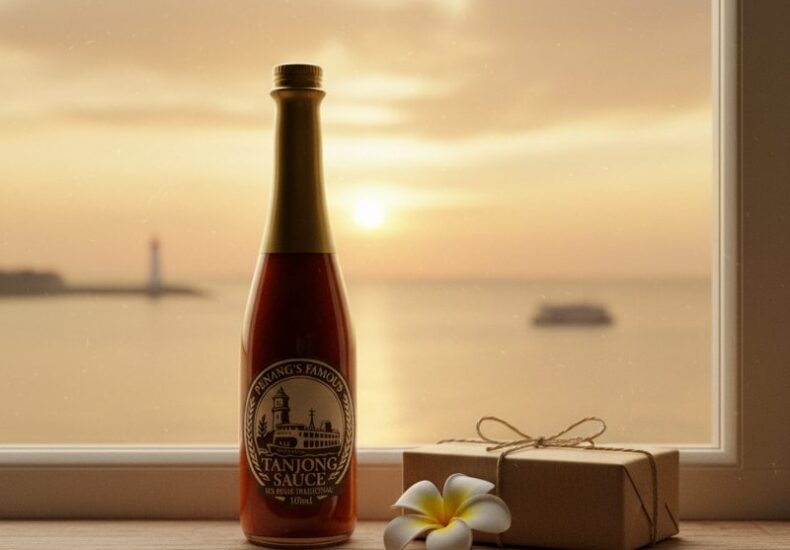
The best food souvenirs do not just taste good. They carry a story. When someone receives a bottle of Tanjong Sauce®, they are not just receiving hot sauce. They are receiving nutmeg – Penang’s signature spice, grown on the hillsides of Balik Pulau. They are receiving a 1970 family recipe from a small-batch kitchen in Simpang Ampat. They are receiving a product that carries three certifications on the label (JAKIM Halal, MeSTI, GS1) and a 24-month shelf life, which means it will still be good when they finally get around to opening it.
The packaging does the storytelling for you. The 100ml glass bottle with its silver cap and gold foil neck wrap looks like something worth giving. The shield-shaped label with Penang’s clock tower and ferry tells the origin story without a word. The kraft paper sleeve adds a layer of unboxing that makes the gift feel considered.
This is not accidental. It is deliberate design, built for the gifting moment. The bottle was designed to be held, looked at, and passed across a table – not just shoved in a cupboard.
The Airport Test
Here is a useful way to think about whether a food souvenir works: can it clear airport security? A 100ml glass bottle of sauce fits in a carry-on liquids bag. It does not need to be checked. It does not need to be wrapped in three layers of clothing to survive the flight. It is, by design, a travel-ready format.
This is not a small detail. Many food souvenirs fail the airport test – jars of sambal that exceed 100ml, fragile glass containers that shatter in luggage, liquid gifts that cannot go in carry-on. A well-designed food souvenir accounts for the journey home, not just the moment of purchase.
The New Malaysian Gift
The shift from trinkets to food is not just about practicality. It is about identity. When Malaysians give food as a gift, they are giving something that is genuinely, irreducibly Malaysian. A fridge magnet made in a factory in Shenzhen with “Malaysia” printed on it is not Malaysian in any meaningful sense. But nutmeg grown in Balik Pulau, combined with seven other ingredients in a kitchen in Simpang Ampat, and bottled under a Penang label – that is Malaysian. You cannot fake provenance.
The next time you need a gift for someone who has everything, skip the souvenir shop. Go to the food aisle instead. Bring them something they can actually taste.
Get Your Three Drops
Tanjong Sauce® – World’s First Halal Nutmeg Hot Sauce. 100ml glass bottle. Made in Penang. A piece of Penang in every drop.
You may also like
Leave a Reply