The Spice Trade Secret: How a Tiny Island in Penang Changed the World’s Kitchens
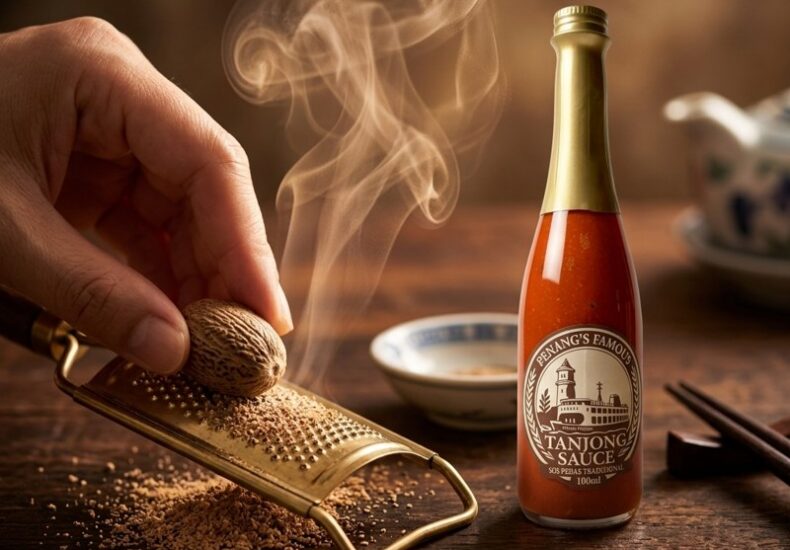
If you have ever sprinkled nutmeg into your eggnog or grated it over a latte, you have tasted a piece of Penang’s history without knowing it.
The story of how nutmeg went from a wild tree on a handful of Indonesian islands to the most fought-over spice in human history is a story of empires, greed, botanical espionage, and one very determined British gardener. But the chapter that matters most for anyone holding a bottle of Tanjong Sauce® today happened right here, on Penang island.
The Spice That Was Worth More Than Gold
In the 1600s, nutmeg was among the most valuable commodities on Earth. A small sack of nutmeg could buy a house in London. The Dutch East India Company — the Amazon of its day, if Amazon also had an army — fought a bloody war to control the Banda Islands, the only place on Earth where nutmeg (Myristica fragrans) grew naturally.
The Dutch won. They established a brutal monopoly, destroying nutmeg trees on any island they could not control and executing anyone caught smuggling seeds or seedlings. For over a century, they dictated the global price of nutmeg — and they made a fortune doing it.
But monopolies never last. And the thing that broke the Dutch nutmeg monopoly was a British botanist, a bribe, and a ship sailing toward Penang.
How Nutmeg Came to Penang
In the late 1700s, the British East India Company established a trading port on Penang island under Captain Francis Light. They saw Penang as a strategic foothold in the Strait of Malacca — a place to dock ships, resupply, and challenge Dutch dominance in the region.
But they also saw something else: Penang’s climate and soil were nearly identical to the Banda Islands. If nutmeg could grow there, the Dutch monopoly would be broken overnight.
The British smuggled nutmeg seedlings out of the Banda Islands — an act that, if caught, carried a death sentence under Dutch law. They planted them in Penang. And they grew.
By the mid-1800s, Penang was one of the world’s largest nutmeg producers. The island’s nutmeg plantations — especially in Balik Pulau, on the island’s western side — produced nutmeg that connoisseurs considered equal to or better than the original Banda stock. Penang nutmeg became a mark of quality in European spice markets.
Why Penang Nutmeg Tastes Different
Here is something most people do not realize: nutmeg is not just nutmeg. Like wine grapes or coffee beans, nutmeg expresses terroir — the unique combination of soil, climate, and growing conditions that shapes its flavour.
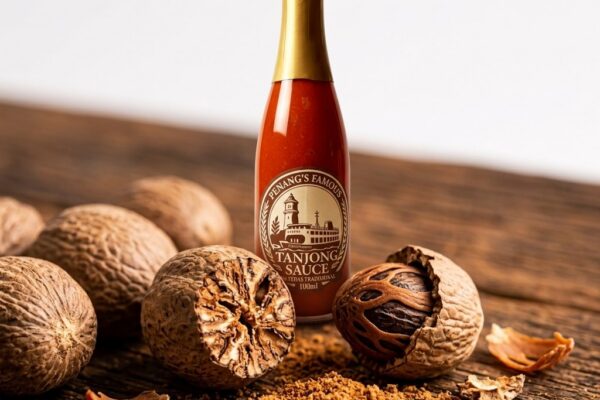
Penang nutmeg (specifically the Myristica fragrans variety grown in Balik Pulau’s laterite-rich soil) has a distinctive profile: warmer, more aromatic, with a slightly higher essential oil content than nutmeg from other regions. The warm-spicy notes are more pronounced. The peppery bite is cleaner. There is an almost floral quality that does not exist in nutmeg grown elsewhere.
This is the nutmeg in Tanjong Sauce®. It is not generic nutmeg powder from a commodity supplier. It is Penang nutmeg — the same nutmeg that 200 years ago was worth its weight in gold and that today still grows on the hillsides of Balik Pulau, farmed by families who have been working the same land for generations.
From Colonial Commodity to Malaysian Kitchen
Nutmeg’s journey from colonial cash crop to everyday Malaysian ingredient is a story of cultural absorption. What the British planted for export, Penangites adopted for themselves.
Today, nutmeg appears across Penang’s food culture: in pickled nutmeg (a sour-spicy condiment served with hawker food), in nutmeg juice (a refreshing drink sold at Balik Pulau roadside stalls), and in countless home kitchens where a pinch of nutmeg powder elevates everything from curry to fried rice.
Tanjong Sauce® is part of that lineage. It is the 1970s family recipe that asked a simple question: what if nutmeg was not just a supporting player in hot sauce, but the lead?
Why This Story Matters
You can buy hot sauce anywhere. You can even buy hot sauce with nutmeg — a few international brands have experimented with it. But you cannot replicate the specific flavour of Penang nutmeg grown in Balik Pulau soil, processed locally, and blended into a sauce made in Simpang Ampat, just 20 minutes from where those nutmeg trees grow.
That is not marketing. That is geography. And it matters every time you taste the difference.
Every bottle of Tanjong Sauce® carries a piece of Penang’s 200-year nutmeg story. Three drops is all it takes to taste it.
Get Tanjong Sauce® — RM12.90
World’s First Halal Nutmeg Hot Sauce. 100ml. Made in Penang, Malaysia.
You may also like
Leave a Reply